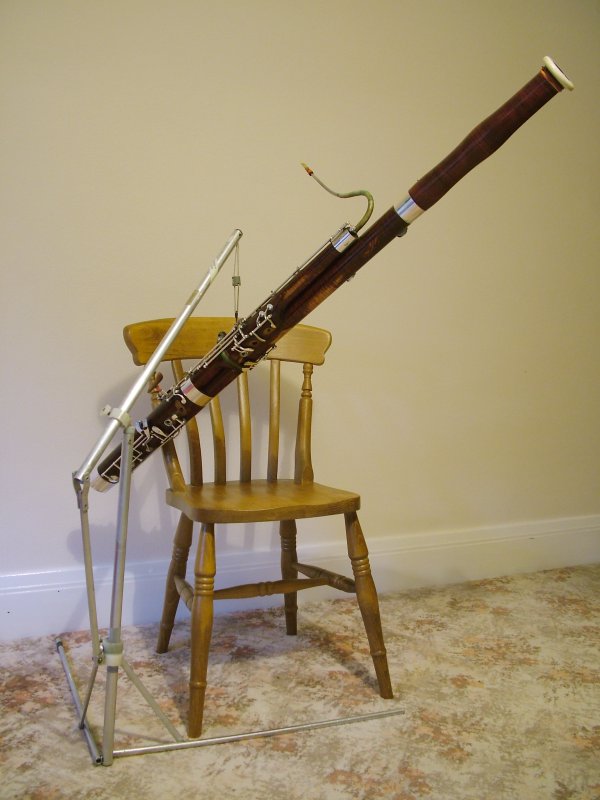
Saturday, September 29, 2012

Saturday, September 8, 2012
An unusual reed


Monday, September 3, 2012
Absolute pitch
The short story is, I don't have it.
Absolute pitch, formerly called perfect pitch, is the ability to name a pitch after hearing it. It's to be distinguished from relative pitch, which is the ability to name intervals after hearing two notes in succession, or at the same time; or copy melodies etc. There's different kinds: some people can do it in some contexts and not others. It's said to be rare: possessing "perfect pitch" is often included in the litany of inborn genius characteristics of the young prodigies, "one in ten thousand". People are studying it, though, and it's a little more complicated than just being a God-given gift to the chosen few. Learning music when being young helps, speaking a tonal language helps. Nearly everyone has some aspect: eg if you ask musically untrained members of the general public to sing a currently popular song, they start in the right key much more often than you would expect from chance. I've known people who had it, in a useful sense: my junior high orchestra director, for instance, would hear an airplane flying overhead, and announce that it was an E, but somewhat flat. And my son's AP is pretty good. I've never had the sense of having perfect pitch, but I feel like I do have some aspects of it. I can imagine playing any note of the bassoon, for instance, hearing the pitch and the timbre in my head, and imagining what my fingers and air column are doing. I'd be surprised if the pitches I'm imagining were that far off. And once when I was trying to learn intervals, with my wife playing them at the piano, she noted that I was always getting major and minor wrong, but was quite accurately calling white notes major and black notes minor. It's wrong, sure, but your brain can't make that kind of mistake without knowing, in some sense, what the absolute pitches are.
So I was intrigued when I read about an online study of AP. Here it is, out of UCSF. They are interested in the genetics, so there are survey questions about family background, musical training, and languages, before they hit you with an online pitch recognition test. I found the pace pretty quick, you get maybe one second for each tone, and I didn't feel like I was doing any better than guessing. About halfway through it switched from pure sine wave tones to piano notes, and I felt like I was doing even worse. I didn't care, I just wanted to finish. The results reflect that: I scored 14.75 on pure tones, and a 3 on piano tones; this is out of a best possible of 36. The average score in their test-taking population is a touch over 17, and random guessing would give you 7.5. Their cutoff for having AP is 24.5. There's a plot of where I fit in:
 A couple of interesting things here: the responses cluster in two places: top right, where you mostly get them right, but with some errors; and middle lower left, around random guessing. So it does mostly look like a "you have it or you don't" binary proposition, though there are lots of intermediate people as well. There's a pretty good correlation between the scores for most participants: if you can do it for one type of tone, you can do it for the other. There are outliers, sure. Mostly these are above the line: people whose AP is pretty good when you play piano notes, not so good for sine waves. This could be a practice effect, people who get better at taking the survey during the survey itself (since the piano notes come second), but I think it's more likely people who grew up playing piano and can just recognize the notes better when they are played by a piano. People like me, who are better at the sine waves, are rarer. I'm not the furthest outlier in this direction, there's a dot way off in the lower right for someone who actually has perfect pitch on sine waves but was as bad as me at piano notes. He or she might have unusual characteristics, or perhaps they just didn't take the second part seriously. My personal results do look pretty funny: definitely better than guessing for sine waves, but worse than guessing for piano notes. Huh. I feel like if the survey had been bassoon notes, or if it has at least been notes in the bassoon range or my singing range, I would have done better. There were a lot of high notes, and I just feel totally lost up in the treble.
Absolute pitch, formerly called perfect pitch, is the ability to name a pitch after hearing it. It's to be distinguished from relative pitch, which is the ability to name intervals after hearing two notes in succession, or at the same time; or copy melodies etc. There's different kinds: some people can do it in some contexts and not others. It's said to be rare: possessing "perfect pitch" is often included in the litany of inborn genius characteristics of the young prodigies, "one in ten thousand". People are studying it, though, and it's a little more complicated than just being a God-given gift to the chosen few. Learning music when being young helps, speaking a tonal language helps. Nearly everyone has some aspect: eg if you ask musically untrained members of the general public to sing a currently popular song, they start in the right key much more often than you would expect from chance. I've known people who had it, in a useful sense: my junior high orchestra director, for instance, would hear an airplane flying overhead, and announce that it was an E, but somewhat flat. And my son's AP is pretty good. I've never had the sense of having perfect pitch, but I feel like I do have some aspects of it. I can imagine playing any note of the bassoon, for instance, hearing the pitch and the timbre in my head, and imagining what my fingers and air column are doing. I'd be surprised if the pitches I'm imagining were that far off. And once when I was trying to learn intervals, with my wife playing them at the piano, she noted that I was always getting major and minor wrong, but was quite accurately calling white notes major and black notes minor. It's wrong, sure, but your brain can't make that kind of mistake without knowing, in some sense, what the absolute pitches are.
So I was intrigued when I read about an online study of AP. Here it is, out of UCSF. They are interested in the genetics, so there are survey questions about family background, musical training, and languages, before they hit you with an online pitch recognition test. I found the pace pretty quick, you get maybe one second for each tone, and I didn't feel like I was doing any better than guessing. About halfway through it switched from pure sine wave tones to piano notes, and I felt like I was doing even worse. I didn't care, I just wanted to finish. The results reflect that: I scored 14.75 on pure tones, and a 3 on piano tones; this is out of a best possible of 36. The average score in their test-taking population is a touch over 17, and random guessing would give you 7.5. Their cutoff for having AP is 24.5. There's a plot of where I fit in:

Monday, August 20, 2012
Velocity
Summer's almost over, with a new year almost begun. At the beginning of the summer, I'd had great plans to make lots of reeds, go busking, get new experiences, and so on. Almost none of that has happened. I did play with that chamber orchestra, and that's about it. Haven't had a lesson in more than a month... unless you count the tabla lesson from my brother, which we did over the computer. Very hard to make that work: the compression algorithms for video conferencing are optimized for speaking voices, and totally chopped off the resonant ring, making it hard to tell whether I was hitting the drum correctly. Really, I should find a local teacher.

One thing I have been trying recently is changing how I practice scales. When I first started up, I wrote out a chart of gradually speeding up scales, starting at 16ths a little under MM=60, and progressing to MM=120 over a year. Just a metronome click or two per month, I thought. How hard could that be? I kept track of how I was doing, and made the plot above. You can see a linear increase for awhile, followed by a big setback, where I got dissatisfied with the beauty and cleanness of the scales, and reset the metronome. I got up again, working faster for a bit, but not much faster overall. I kinda topped out at 70, and found it hard to do more, playing every key, major and minor, full compass. I then got sick of how much of my limited time I was putting into scales, and stopped recording the speed progress. Overall I tracked this for maybe 8 months total. Since then, I've still played scales, but mostly in the 60-70 window, and experimented tried adding different articulations, etc., but generally trying to not spend too much time on them.
So my new idea is that if I want to be able to play smoothly fast, then I should work on doing just that. New plan: start at MM=100, but very restricted: only C, F, and G, and only five notes at a time, if that's what I can do cleanly and beautifully. I'll try to work my way to playing one octave, up and down, then expand from there, in range and number of scales. If I want to play clean and fast, then do that. We'll see what happens.

One thing I have been trying recently is changing how I practice scales. When I first started up, I wrote out a chart of gradually speeding up scales, starting at 16ths a little under MM=60, and progressing to MM=120 over a year. Just a metronome click or two per month, I thought. How hard could that be? I kept track of how I was doing, and made the plot above. You can see a linear increase for awhile, followed by a big setback, where I got dissatisfied with the beauty and cleanness of the scales, and reset the metronome. I got up again, working faster for a bit, but not much faster overall. I kinda topped out at 70, and found it hard to do more, playing every key, major and minor, full compass. I then got sick of how much of my limited time I was putting into scales, and stopped recording the speed progress. Overall I tracked this for maybe 8 months total. Since then, I've still played scales, but mostly in the 60-70 window, and experimented tried adding different articulations, etc., but generally trying to not spend too much time on them.
So my new idea is that if I want to be able to play smoothly fast, then I should work on doing just that. New plan: start at MM=100, but very restricted: only C, F, and G, and only five notes at a time, if that's what I can do cleanly and beautifully. I'll try to work my way to playing one octave, up and down, then expand from there, in range and number of scales. If I want to play clean and fast, then do that. We'll see what happens.
Monday, August 6, 2012
Back from a break
I had two weeks off, which was mostly spent driving. My dad's 90th birthday was this year, which turned into a kind of family reunion. Driving down for that, plus dropping my wife at a jazz piano camp, and general tourism on the way out and back resulted in about 7000 km behind the wheel. I didn't bring the bassoon, just because I didn't want to fret about it. Not very much bassoon-related happened; the closest thing was wearing a bassoon T-shirt while hiking in Zion National Park, and getting greeted by a clarinettist. We chatted briefly, he went to school with some Canadian bassoonists that I've heard of. After google-stalking him, it seems that I met Richard Peck, of the Houston Symphony.
The downside to not practicing is that I have a rehearsal tonight, with a fairly high level group, and have to be able to play. I've had just over a day back, enough time to play a few long tones against a drone, but that's about it. Hopefully I won't embarrass myself too badly. This is the last rehearsal before the show, and I missed the previous rehearsal due to being away.
The other music-related thing was being given a set of tablas by my mother. It's not the first hand-drum I have, my wife gave me a small djembe for Christmas a few years ago, which I play occasionally. Tablas are different though; they are a vital part of Indian classical music, which has its own traditions as serious as Western classical music. My mom made me promise to take at least a lesson or two on them before she let me take them away. We'll see how that goes.
Update: The rehearsal went fine. I even got singled out for praise at the end, which was an odd kind of feeling. There was a solo-ey phrase (Dvorak 8, 2nd movement), which I was trying to play out, and heard a violin. I glanced over, being reminded that this bit was doubled with a solo violin. (Or, depending on where you sit, the solo violin is doubled by a bassoon.) Our student conductor, who'd spent the last part of rehearsal importuning the winds to listen more to our rather overbalanced strings, caught this and pointed it out as an example of what we ought to be doing. Okay, so I did end up a bit embarrassed, but not in the way that I feared. I also found out that the conductor knew my name, so that was nice too. I'm terrible with names, so I'm always impressed whenever anyone uses mine.
The downside to not practicing is that I have a rehearsal tonight, with a fairly high level group, and have to be able to play. I've had just over a day back, enough time to play a few long tones against a drone, but that's about it. Hopefully I won't embarrass myself too badly. This is the last rehearsal before the show, and I missed the previous rehearsal due to being away.
The other music-related thing was being given a set of tablas by my mother. It's not the first hand-drum I have, my wife gave me a small djembe for Christmas a few years ago, which I play occasionally. Tablas are different though; they are a vital part of Indian classical music, which has its own traditions as serious as Western classical music. My mom made me promise to take at least a lesson or two on them before she let me take them away. We'll see how that goes.
Update: The rehearsal went fine. I even got singled out for praise at the end, which was an odd kind of feeling. There was a solo-ey phrase (Dvorak 8, 2nd movement), which I was trying to play out, and heard a violin. I glanced over, being reminded that this bit was doubled with a solo violin. (Or, depending on where you sit, the solo violin is doubled by a bassoon.) Our student conductor, who'd spent the last part of rehearsal importuning the winds to listen more to our rather overbalanced strings, caught this and pointed it out as an example of what we ought to be doing. Okay, so I did end up a bit embarrassed, but not in the way that I feared. I also found out that the conductor knew my name, so that was nice too. I'm terrible with names, so I'm always impressed whenever anyone uses mine.
Thursday, July 19, 2012
Behold the magic powers of awesome bass
DARPA (you know, those guys who actually did invent the internet) has a piece on using "acoustic fields" (ie, killer bass) to snuff out flames. Looks like magic to me!
It's totally not clear to me, from the video, what the sound spectrum being used is, or (perhaps more importantly?) what sound pressure levels are required. All I hear is a buzz. It's not so loud that there can't be a person standing next to it (perhaps wearing ear protection), but it seems to require two huge speakers on either side of the flame, attached to ginormous tubes. Also, after the flame is out, the sound switches off, accompanied by a loud click, as if a huge relay is required to maintain the "acoustic field". Here's what they say about it:
It's totally not clear to me, from the video, what the sound spectrum being used is, or (perhaps more importantly?) what sound pressure levels are required. All I hear is a buzz. It's not so loud that there can't be a person standing next to it (perhaps wearing ear protection), but it seems to require two huge speakers on either side of the flame, attached to ginormous tubes. Also, after the flame is out, the sound switches off, accompanied by a loud click, as if a huge relay is required to maintain the "acoustic field". Here's what they say about it:
Performers also evaluated the use of acoustic fields to suppress flames. In the video below, a flame is extinguished by an acoustic field generated by speakers on either side of the pool of fuel. Two dynamics are at play in this approach. First, the acoustic field increases the air velocity. As the velocity goes up, the flame boundary layer, where combustion occurs, thins, making it easier to disrupt the flame. Second, by disturbing the pool surface, the acoustic field leads to higher fuel vaporization, which widens the flame, but also drops the overall flame temperature. Combustion is disrupted as the same amount of heat is spread over a larger area. Essentially, in this demonstration the performers used speakers to blast sound at specific frequencies that extinguish the flame.My reaction: yeah, I know lots of those words. It's still magic.
Monday, July 16, 2012
The Audition
Here's a great article about the audition process at a Big 5 orchestra. The BSO had not one but two percussion positions open, a highly unusual circumstance. The article follows the preparations of one of the candidates, following through his getting cut in the first round. It also covers the story of why there were two positions open: a previous job winner, a former classmate and friend of the main candidate, didn't get tenure. The article gives the public a lot of detail about that process, a lot of comments about what went wrong. Very unusual, I think, and very informative.
I have a number of reactions when reading about this. Sympathy, number one. Sympathy for all the participants in what seems to me to be a terrible system. Relief is another. Had I made different choices as a teenager, that could have been me. Maybe I would have been one of the lucky ones, who knows, and ended up with an orchestra job. And then spent my life performing the standard repertoire, over and over, to increasingly gray-haired audiences. Imagining it, I'm not sure "winning" is the right term for this outcome.
Finally, annoyance. Do these people really not see that the audition process is at the root of the cultural ossification of classical music? Maybe one could defend the process as necessary to find the best musicians. Classical music performance is demanding and conservative, I get that, and you want to find and train people who can do it well at a high level, making as few mistakes as humanly possible. But classical music performance is by no means the only profession where mistakes are to be avoided. Off the top of my head, I can name other demanding, high risk job: venture capitalist, jet fighter pilot, and heart surgeon, say. Every mistake a VC makes costs $20M, or whatever they risked on their investment. Fighter pilot errors cost about the same, assuming they eject and survive, and the only loss is the taxpayer's plane. Surgical errors are even worse: they kill people. Does anyone really think that a few wrong notes in a marimba solo have anything like the consequences for society as errors in these other fields? And yet, somehow, we are able to train and select VCs, pilots, and surgeons in a manner that's both more humane and, I expect, more effective than the one classical music uses. Yes, more humane, and yes, I know about residency. These fields work the trainees extremely hard, in the name of having them as prepared as possible for their high risk, high impact jobs, but the existence of the careers themselves are not at risk. Once you get into med school, to pick one example, you're basically guaranteed, barring some disaster, to end up a physician. Classical music puts the selection bar at the very end, after people have invested decades, and grants a sustainable career entirely on the success of a single artificial performance.
Moreover, the process has bad implications for the art itself. People will seek to achieve their pinnacle at whatever metric is the most critical. Success at the job audition, because the stakes are so high, is that most critical metric. Get better at some other metric, pleasing audiences say, or convincing them to come and pay, and you risk being beaten by candidates who are better at pleasing audition committees. The more competitive the environment, the more risk adverse the candidates and the committees become. And once people are in the system, having passed through the hazing, they become captive to the system, serving on committees, defending the system that granted them a job against any efforts to change.
Can you imagine what pop music would sound like if performers were selected in the same manner? Lots of really fabulous, high quality renditions of Elvis tunes. And they'd require government support, since only handfuls of devotees would turn out. It's no wonder, as Sandow points out over and over, that classical audiences are both dwindling and greying. I don't know if the audition process is the entirety of the problem, but I feel confident it's a large part of it. For every organization, how you hire defines your culture. Is the audition process creating the culture that classical music needs to thrive?
I have a number of reactions when reading about this. Sympathy, number one. Sympathy for all the participants in what seems to me to be a terrible system. Relief is another. Had I made different choices as a teenager, that could have been me. Maybe I would have been one of the lucky ones, who knows, and ended up with an orchestra job. And then spent my life performing the standard repertoire, over and over, to increasingly gray-haired audiences. Imagining it, I'm not sure "winning" is the right term for this outcome.
Finally, annoyance. Do these people really not see that the audition process is at the root of the cultural ossification of classical music? Maybe one could defend the process as necessary to find the best musicians. Classical music performance is demanding and conservative, I get that, and you want to find and train people who can do it well at a high level, making as few mistakes as humanly possible. But classical music performance is by no means the only profession where mistakes are to be avoided. Off the top of my head, I can name other demanding, high risk job: venture capitalist, jet fighter pilot, and heart surgeon, say. Every mistake a VC makes costs $20M, or whatever they risked on their investment. Fighter pilot errors cost about the same, assuming they eject and survive, and the only loss is the taxpayer's plane. Surgical errors are even worse: they kill people. Does anyone really think that a few wrong notes in a marimba solo have anything like the consequences for society as errors in these other fields? And yet, somehow, we are able to train and select VCs, pilots, and surgeons in a manner that's both more humane and, I expect, more effective than the one classical music uses. Yes, more humane, and yes, I know about residency. These fields work the trainees extremely hard, in the name of having them as prepared as possible for their high risk, high impact jobs, but the existence of the careers themselves are not at risk. Once you get into med school, to pick one example, you're basically guaranteed, barring some disaster, to end up a physician. Classical music puts the selection bar at the very end, after people have invested decades, and grants a sustainable career entirely on the success of a single artificial performance.
Moreover, the process has bad implications for the art itself. People will seek to achieve their pinnacle at whatever metric is the most critical. Success at the job audition, because the stakes are so high, is that most critical metric. Get better at some other metric, pleasing audiences say, or convincing them to come and pay, and you risk being beaten by candidates who are better at pleasing audition committees. The more competitive the environment, the more risk adverse the candidates and the committees become. And once people are in the system, having passed through the hazing, they become captive to the system, serving on committees, defending the system that granted them a job against any efforts to change.
Can you imagine what pop music would sound like if performers were selected in the same manner? Lots of really fabulous, high quality renditions of Elvis tunes. And they'd require government support, since only handfuls of devotees would turn out. It's no wonder, as Sandow points out over and over, that classical audiences are both dwindling and greying. I don't know if the audition process is the entirety of the problem, but I feel confident it's a large part of it. For every organization, how you hire defines your culture. Is the audition process creating the culture that classical music needs to thrive?
Subscribe to:
Posts (Atom)