Friday, May 30, 2025
MRI of an opera singer
This has been sitting in my drafts for nine years. Absolutely amazing, to see how they dynamically reshape their anatomy to make the sound. And apparently, I'm still logged in. Speaking of which, hi to anyone reading this!

Monday, September 15, 2014

Monday, August 4, 2014
The patented Grundmann bocal bend

I didn't know you could patent a bocal bend. But apparently you can. Trent Jacobs mentioned that only Wolf is licensed to do the Grundmann bend, so I went looking for the patent. Here it is in German, and Google shows an English translation. The bocals themselves are available from MMI.
Sunday, August 3, 2014
The scoop on ivory bell rings
MMI recently replaced an ivory ring on a 12k Heckel with synthetic, due to concerns about its salability. Pictures here. So what's the deal with ivory these days?
Well, the full story is a little complicated. Wikipedia has an article on the Ivory trade, with some history and mostly focusing on elephant ivory. Continued poaching of elephants has led to increased regulation and enforcement of their products. Here are the rules surrounding ivory in the US in 2014. Import, export, interstate movement, and use of African elephant ivory ranges from "maybe okay under restrictive rules" to "banned, item destroyed and maybe even go to jail". So what do you do if you have a bassoon with an ivory bell ring?
The first question is what kind of ivory you have -- there are lots of hard white materials that didn't come from an African elephant. The US Fish and Wildlife Service has an ivory identification guide, with photos, flowcharts, and recommended lab procedures. The most relevant to bassoonist is identifying elephant ivories, which can be recognized by what are called Schreger lines in cross sections of the dentine. Here are pics of what they look like in elephant and mammoth:


Now, most of the rules are about elephant ivory, so if your bell ring is made of steel, or synthetic, or tagua nut, you're fine. If it's an especially good simulation of elephant ivory, you may want to keep documentation with the instrument, in case questions come up. I don't know if bassoon bell rings are ever made of animal ivories not from elephants, but if they are, you should be able to identify the species using the flowchart and read up on the rules.
Mammoths are an interesting case. Mammoths aren't endangered, they are extinct, and have been for 10,000 years. So while there is a reasonable amount of mammoth ivory around, it is not covered under CITES and related rules: there's no risk to the species, since it's already dead. Look at the picture, though: it's gorgeous. I don't know if mammoth has ever been used for bell rings.


Schreger lines are definitely present, which means elephant or mammoth. It's not so easy to tell, since we don't have the whole cross section to look at, but to my untrained eye the angles look more like the elephant picture than the mammoth picture. So: probably elephant ivory.
Now we're into complicated rules territory. If the material in question was removed from the wild prior to Feb 26, 1976, and there is sufficient documentation of that fact, various pieces of paper can be gotten to show to interested officials. The US forms for musical instruments start here. If you travel frequently with an instrument, bring as much paperwork as possible to impress the border officers with your diligence and awareness. The League of American Orchestras has more reading here. No one wants to end up with their instrument in government impound or worse.
EDIT: more links.
Well, the full story is a little complicated. Wikipedia has an article on the Ivory trade, with some history and mostly focusing on elephant ivory. Continued poaching of elephants has led to increased regulation and enforcement of their products. Here are the rules surrounding ivory in the US in 2014. Import, export, interstate movement, and use of African elephant ivory ranges from "maybe okay under restrictive rules" to "banned, item destroyed and maybe even go to jail". So what do you do if you have a bassoon with an ivory bell ring?
The first question is what kind of ivory you have -- there are lots of hard white materials that didn't come from an African elephant. The US Fish and Wildlife Service has an ivory identification guide, with photos, flowcharts, and recommended lab procedures. The most relevant to bassoonist is identifying elephant ivories, which can be recognized by what are called Schreger lines in cross sections of the dentine. Here are pics of what they look like in elephant and mammoth:

Schreger lines in elephant ivory

Schreger lines in mammoth ivory
Now, most of the rules are about elephant ivory, so if your bell ring is made of steel, or synthetic, or tagua nut, you're fine. If it's an especially good simulation of elephant ivory, you may want to keep documentation with the instrument, in case questions come up. I don't know if bassoon bell rings are ever made of animal ivories not from elephants, but if they are, you should be able to identify the species using the flowchart and read up on the rules.
Mammoths are an interesting case. Mammoths aren't endangered, they are extinct, and have been for 10,000 years. So while there is a reasonable amount of mammoth ivory around, it is not covered under CITES and related rules: there's no risk to the species, since it's already dead. Look at the picture, though: it's gorgeous. I don't know if mammoth has ever been used for bell rings.
As a practical example, here's an end view of a bassoon bell:
End view of a bassoon bell
Same photo, enlarged and processed
Schreger lines are definitely present, which means elephant or mammoth. It's not so easy to tell, since we don't have the whole cross section to look at, but to my untrained eye the angles look more like the elephant picture than the mammoth picture. So: probably elephant ivory.
Now we're into complicated rules territory. If the material in question was removed from the wild prior to Feb 26, 1976, and there is sufficient documentation of that fact, various pieces of paper can be gotten to show to interested officials. The US forms for musical instruments start here. If you travel frequently with an instrument, bring as much paperwork as possible to impress the border officers with your diligence and awareness. The League of American Orchestras has more reading here. No one wants to end up with their instrument in government impound or worse.
EDIT: more links.
- http://www.fretboardjournal.com/features/magazine/guitar-lover%E2%80%99s-guide-cites-conservation-treaty
- http://slippedisc.com/2014/05/us-makes-it-easier-to-fly-with-ivory-tips-beware-the-strings-attached/
- http://americanorchestras.org/advocacy-government/travel-with-instruments/endangered-species-material/protected-species-travel-tips.html
Saturday, March 8, 2014
The recurve bow
My son was explaining that the standard modern bow, the recurve bow, was in fact only invented in about 1750. Before that, the bow allowed triple and quadruple stops to be played solid, instead of broken as in modern performance practice. This video shows a selection from a Bach cello suite being performed with a historical bow. Recurve bows allow the normal types of staccato we're used to hearing these days, however.
Wednesday, February 19, 2014
This is my bassoon

Sunday, January 26, 2014
Gustav Holst wrote a wind quintet
Gustav Holst wrote a wind quintet! It's not well known, and was in fact lost for many years. Written in 1903, the manuscript was rediscovered in 1978, and it received its official world premiere in 2006. More than a century between composition and performance, that must be some kind of record. Raymond Head seems to have edited the definitive edition, which is available from his web site.
Friday, October 18, 2013
A language that can be whistled or hummed
This piece in Slate led me to Pirahã, an Amazonian language with odd characteristics: no numbers, no colors, and very few consonants and vowels. The simplicity of sounds is compensated by complex tones, stresses, and syllable lengths, such that speakers can supposedly converse entirely with whistles or humming. Astonishing, if true: I wonder sometimes how many of these amazing anthropological discoveries are simply natives playing jokes on credulous adventurers. Still, in the context of the "music is a language" idea, here we have a natural language which can not only be entirely translated into music, but which itself remains entirely comprehensible if the non-musical aspects (ie ordinary phonemes) are removed. Wow. There's also a long New Yorker piece from 2007 that the Slate story is based on.
Wednesday, October 9, 2013
Nobelist: I owe it all to bassoon

There are lots of famous people who are secretly bassoonists. Thomas Sudhof, who just got the Nobel prize in Medicine for his work on vesicle trafficking, is one of them. Here's a quote from a 2009 interview:
Who was your most influential teacher, and why?My bassoon teacher, Herbert Tauscher, who taught me that the only way to do something right is to practice and listen and practice and listen, hours, and hours, and hours.
Wednesday, June 12, 2013
Never cry wolf
The film adaptation of Farley Mowat's Never Cry Wolf features the bassoon prominently. This is a fictive addition by the filmmakers, as Mowat never mentions a bassoon, but it's a small change to an already somewhat fictional book, and it makes us bassoonists happy. Here's one of the appearances of the bassoon:
Wow, I can't sound like that in my living room, much less outside in the snow. Still, gorgeous playing --- David Wells says it's Rufus Oliver of the SF Opera. David also writes quite a bit more about the movie. There's also a discussion of it on the excellent and new-to-me blog, Dr. Pierce's Bassoon Studio.
Wow, I can't sound like that in my living room, much less outside in the snow. Still, gorgeous playing --- David Wells says it's Rufus Oliver of the SF Opera. David also writes quite a bit more about the movie. There's also a discussion of it on the excellent and new-to-me blog, Dr. Pierce's Bassoon Studio.
Tuesday, June 11, 2013
How to annoy the bassoonist
It's totally unclear to me how this is working, exactly. With the valve slides gone, we're left with a fairly short, cylindrical bore. Why does that sound anything like a bassoon? Hm.
And, for those who'd like to sing along, here are the lyrics:
"I... am not an english horn. // I am not an english horn, I cannot play so high // I am not an english horn..."
Wednesday, June 5, 2013
The Savary bassoon

The Savary Bassoon refers to instruments made by the Parisian maker Jean-Nicolas Savary. His dates are 1768-1853, so I guess these would count as classical or early romantic instruments, coming just before the changes of Heckel and Almenrader. The photo above shows an x-ray of the wing joint of one of the remaining examples. I love this image: you can see the long tone holes that give the bassoon its unique sound, as well as the subtle changes in the taper of the main bore that the maker used to balance various characteristics.
There's been a recent effort to reconstruct one of these instruments, documented in the video below. I'm not a big fan of calling anything the "Stradavarius of X", unless X is a violin, but the instrument has a gorgeous sound, quite different from the modern bassoon.
Friday, May 24, 2013
Tuesday, May 21, 2013
Is this possible for anyone to play?
From Saxton Rose, music by Philippe Hersant:

Looking at that, I have a hard time figuring out what sounds the composer wants, and why he thinks the bassoon will make them. Perhaps there's someone who can play that as written, but I'm quite sure I never will. The leaps are too large, and too quick. Surely, we're not meant to interpret the notes literally, are we??
Wait! There's also flutter tonguing? Really? Now, if it's possible, I'm even more confused.
Monday, April 22, 2013
Looping with Google Glass
Nice, catchy little piece. And the first person view of the whole process is fun.
Sunday, March 24, 2013
The Heckelphone
I've seen pictures of the Heckelphone, but I don't think I've heard it before. Here's a recording of the Hindemith Heckelphone trio:
Monday, March 11, 2013
Paid to play

It wasn't the first time I've been paid to play. I'd done a few gigs in high school. But that was a long time ago -- I was probably 17 the last time I got a check for playing bassoon. I gotta say, it was incredibly fun. Stressful, sure. I tried to be in top form, as focused, prepared and professional as possible, but before and during the sessions. And being around excellent playing makes it easier to be excellent, as well as making it more obvious when I wasn't. It was great fun to do, to just be there, being a part of it. And then there were times my mind wandered away from the music, to giddily thinking, "I'm being paid to do this!" An incredible feeling.
I didn't learn the amount until after I'd gotten home. It's more than I expected, to be honest. I would have been happy if it had covered the cost of parking. But I can do the math, and be reminded of how difficult it would be to make a living as a freelancer. Still, it was fun to do, when I don't need to try and make a living from it. Hopefully, I did well enough that I'll get a call again sometime.
Thursday, February 28, 2013
SF oboist dies in hospital

William Bennett, the San Francisco Symphony principal who collapsed while playing the Richard Strauss concerto on Saturday night, died today in hospital. He was 56 years old
Sad news.
[h/t Slipped Disc]
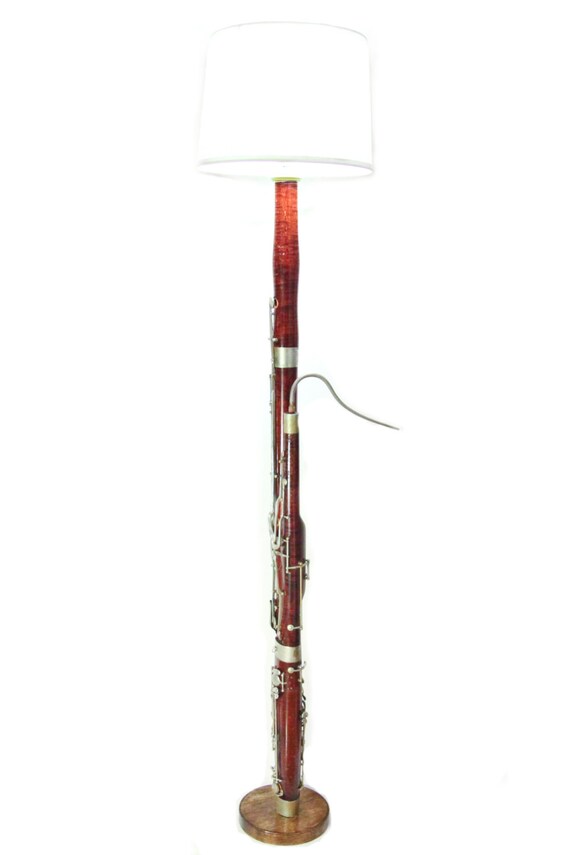
Bassoon lamp
I've often heard of "lamp-quality" bassoons, but I've never actually seen a lamp. Here's one you can buy on Etsy:
 The bocal's backwards, sure, probably an artistic choice for the photo. I'm more curious about the lack of whisper key. Did it fall off, or is the horn old enough that it never had one? Regardless, this horn seems to have entered a new phase of life as a decorative object.
Subscribe to:
Posts (Atom)